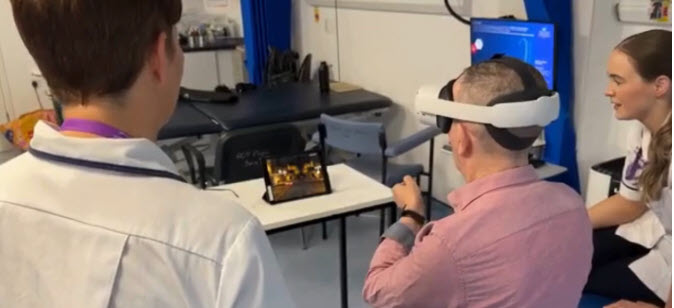

Immersive tech is beginning to address the well-known challenge of therapeutic dosage. It’s widely recognised within the field of neuroplasticity that the restoration of motor function following a cerebrovascular accident is heavily dependent upon high-repetition, task-specific training. However, traditional occupational therapy often struggles to facilitate the volume of movement necessary to trigger cortical reorganisation, frequently limited by patient fatigue, time constraints, and the inherent monotony of repetitive exercises. The recent collaborative pilot study conducted by the Belfast Health and Social Care Trust, in partnership with the medtech firm eXRt, has provided compelling empirical evidence that virtual reality (VR) can bridge this gap. By trialling the Resynk platform, researchers have demonstrated that integrating digital immersion into standard care pathways can increase upper limb movement repetitions by as much as 500 per cent compared to conventional methods.
The technical efficacy of the Resynk platform lies in its ability to translate standard physiological movements into interactive, arcade-style feedback loops that bypass the psychological barriers to repetition. During the six-month longitudinal pilot, stroke survivors were subjected to a hybrid regimen consisting of both traditional occupational therapy and gamified VR sessions. The primary objective was to quantify the disparity in movement volume and evaluate the qualitative impact on patient engagement. The results were statistically profound; the immersive nature of the VR environment provided a continuous stream of visual and auditory stimuli that maintained the participants’ attention and drive. This engagement resulted in a surge of physical output, with one notable case study recording nearly 800 reps in a single thirty-minute session; a volume that is pretty much unattainable through standard manual therapy alone.
Furthermore, the study highlighted the critical importance of portability and environmental flexibility in modern neuro-rehabilitation. The Resynk system was designed to be utilised in various clinical settings, including at the patient’s bedside, in a seated position, or within a dedicated rehabilitation suite. This flexibility is essential for acute and sub-acute stroke survivors whose mobility may be restricted, allowing for the immediate commencement of high-intensity training. By facilitating such a massive increase in movement volume, the platform aligns with the latest clinical guidelines which advocate for more intensive therapy to maximise functional independence. The success of the Belfast trial suggests that stroke recovery in the UK will increasingly rely on these sophisticated digital interventions to supplement manual therapy and ensure that survivors reach the critical threshold of repetition required for meaningful neurological recovery.