Your Stroke / Brain Injury Recovery Starts Here


ARNI home-based training and guidance for your rehab is POWERFUL. Accept no substitute.

2026 marks 25 years of ARNI: Click Here to Claim your £50 off Full Set of Stroke Rehab 7 DVDs TODAY!

News

An update of ‘where we are’ as far as stem cell therapy for stroke survivors is concerned. So, stem cell therapy is, as you probably know very well, not currently recommended as a standard treatment for ischemic stroke patients due to insufficient evidence of clinical efficacy, despite promising preclinical results.
Despite the limitations of current standard treatments, stem cell therapy remains investigational. No mention of stem cell therapy appears in any of the major stroke treatment guidelines.
Multiple stem cell types have been investigated in preclinical and clinical studies:
  • Mesenchymal stem cells
  • Neural stem cells
  • Bone marrow mononuclear cells
  • Embryonic stem cells
  • Induced pluripotent stem cell-derived neural stem cells
Proposed mechanisms of action include:
  • Cell differentiation and replacement
  • Immunomodulation
  • Neural circuit reconstruction
  • Release of protective factors
The most recent and highest quality evidence comes from a 2021 systematic review and meta-analysis of randomized controlled trials. An analysis of 8 RCTs involving 459 subjects (217 intervention, 242 controls) shows:
  • No significant reduction in neurological deficit (NIHSS score) in acute or subacute stroke
  • Some benefit observed in chronic stroke patients, but clinical significance unclear
  • No statistically significant reduction in mortality rates
Overall conclusion: No clinically important evidence for efficacy of stem cells in reducing neurological deficit compared to control group.
Challenges and Limitations
Several issues remain unresolved regarding stem cell therapy for stroke:
  • Cell type selection
  • Dosing regimens
  • Delivery routes (IV vs. intra-arterial)
  • Timing of administration
  • Translation challenges from bench to bedside:
  • Conflicting results between preclinical and clinical studies
  • Mechanisms of action not fully understood
  • Limited therapeutic window in most clinical trials
So, patients reading the ARNI News page who are  interested in stem cell therapy should be referred to centers conducting approved clinical trials, avoiding unproven commercial stem cell treatments outside of regulated research settings. While stem cell therapy shows theoretical promise for ischemic stroke treatment, current evidence does not support its use in routine clinical practice. Established treatments like thrombolysis and endovascular therapy remain the standard of care for improving outcomes in ischemic stroke patients.
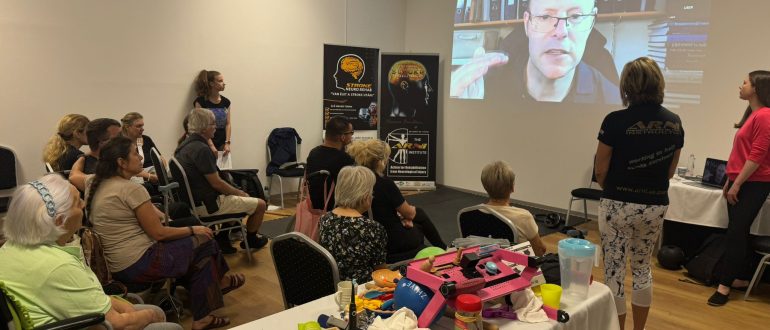
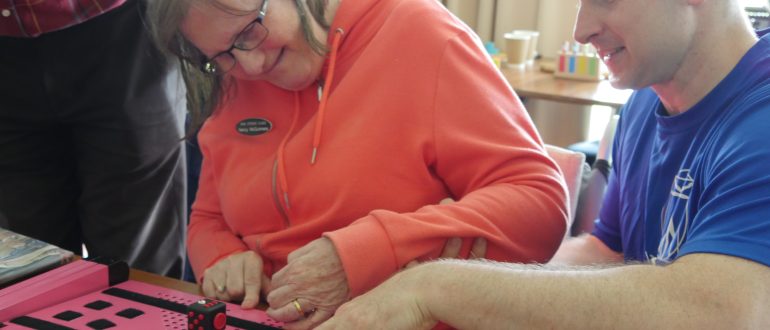
The 3 day annual Hungarian Specialist ARNI Stroke Rehabilitation Course for 18 physiotherapists and Rehab Training for stroke survivors which took place last weekend in Budapest! A huge well done and thank you to all involved, particularly Mrs. Gabi Pasztor, our Senior ARNI Associate Instructor and International Development Officer. Dr Tom delivered the course virtually this time: this was our 6th 3-day course in as many years.

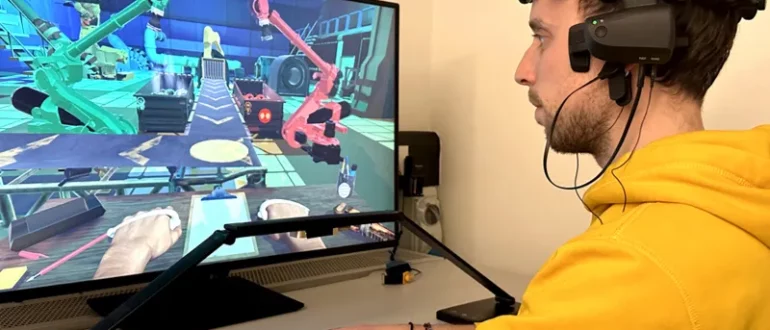
A new UK study is investigating whether a brain-controlled computer game can help stroke survivors recover movement in their more-affected upper limb.
Participants will wear a wireless headset that records brain activity as they imagine moving their affected arm, with those signals used to control a computer game.
The research, led by Queen’s University Belfast (QUB), is recruiting around 50 people who have had a stroke. It aims to harness neuroplasticity – the brain’s ability to reorganise and allow other regions to take over lost functions.
Many stroke survivors find everyday tasks such as dressing, cooking or writing extremely difficult. Different types of rehabilitation, including game-based approaches, can offer support.
Dr Kathy Ruddy, a neuroscientist leading the research, said: “The brain signals are picked up and used to control a computer game.
“This form of ‘motor imagery’ activates the same brain areas as real movement and it may help keep these body parts healthy and active after a stroke, even when actual movement isn’t yet possible.”
The team at QUB said the research is giving hope to people whose movement or speech remains affected after stroke.

This superb graph created by ARNI supporter Professor Peter Langhorne for his excellent journal article in The Lancet (also shown in Dr Balchin’ ‘Had a Stroke’, Now What’) shows that a fixed therapeutic time window of 3/6 months doesn’t necessarily exist – this is proof that you can show all the naysayers.

This is ‘hope in a graph’ as far as I’m concerned – it means that there is no real “end” to recovery and that you CAN continue to recover and do better in terms of action control after many years have passed as long as you continue to stretch to keep muscles long/pliable, do as many ADLs as possible and do at least one ‘Rehabby Hobby’ as Dr Tom calls it.

His main intensive ‘rehabby hobby’ was DJing. You can read about exactly how he used this in ‘Had a Stroke’, Now What’ and can get ideas about other hobbies which challenge the paretic upper limb to the max 😉

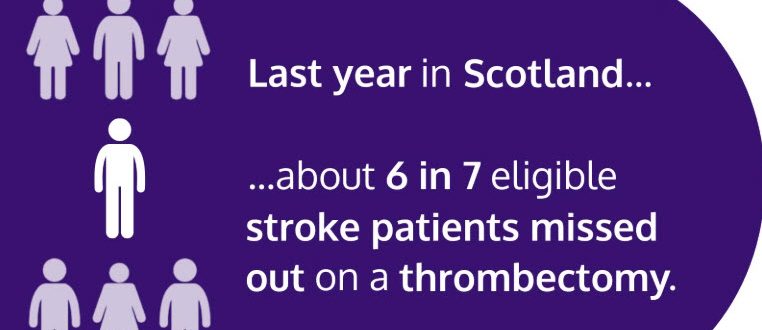
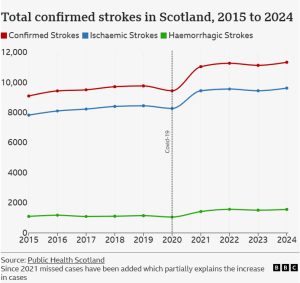
Data from Public Health Scotland (PHS) shows 11,341 people had a final diagnosis of a stroke in 2024, compared to 11,137 in the previous year. But only HALF of these people actually got access to the appropriate treatment they needed.

Such measures include giving patients aspirin and transferring quickly to specialist wards: vital to ensure the best chance of survival and recovery.

The Scottish government responded yesterday that it is investing £52m in stroke care and is working with health boards to drive up standards of local treatment.

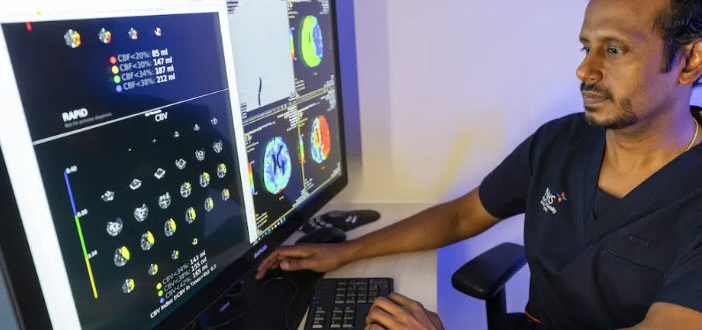
Stroke patients at an English hospital are getting quicker diagnoses with artificial intelligence that gives consultants instant access to brain scan images. The system in Russells Hall Hospital in Dudley introduced RapidAI to speed up triage – prioritising patients by urgency – by sending scans directly to consultants’ mobile phones.

The technology speeds up the triage process by providing instant access to diagnostic imaging, accompanied by preliminary reports for clinicians to quickly verify and act upon – significantly improving response times and outcomes.

The technology also flags suspected strokes in patients that may not show traditional clinical signs, such as speech problems or a droopy face or eye.

It means patients can receive potentially life-saving treatments earlier.

Since its introduction at Dudley Group NHS Foundation Trust, patients have been diagnosed within 40–60 minutes – up to an hour faster than without the technology. When it comes to strokes, obviously every second counts. We’re told that the government plans to roll out AI use across the NHS as part of a 10-year shift from analogue to digital systems.

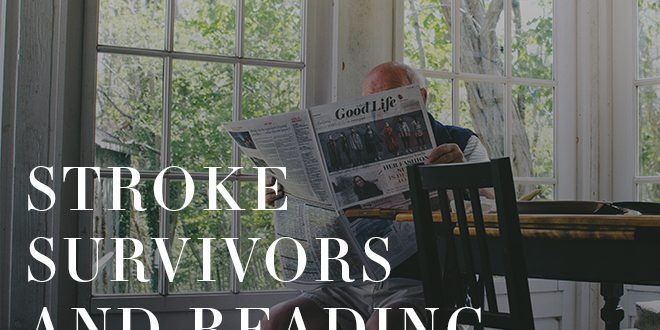
It’s long been known that people who experience a stroke can struggle with reading, but researchers weren’t clear exactly why. Now, a new study, led by researchers at Georgetown University, reveals that strokes can limit a person’s ability to use the meaning of words to help them recognize the words when reading.
The finding presents a possible opportunity for new therapeutic strategies to help people recover one of the most important life skills. Researchers looked at scanned images of brains damaged by stroke while study participants read aloud. They were then able to pinpoint a part of the brain and related connections that affect how deciphering the meanings of words facilitates reading. They determined that the reason some stroke survivors can’t use meanings of words to read is because they can’t map the words they are trying to pronounce back to the ideas behind the words.
The researchers also mapped the extent of the strokes with MRI imaging. The images revealed that damage along the superior temporal sulcus, a brain region that plays a crucial role in speech processing and auditory , reduced the advantage of being able to read high imageability over low imageability words, reflecting an inability to use meaning to support reading.They also found an overlapping brain region that was related to impairments in connecting meanings of words to their sounds, or phonology. Together, these results demonstrate that some reading deficits occur in left-hemisphere stroke survivors as a result of an impaired integration of meaning and phonology.
These findings clarify the neurobiology of reading and provide the strongest evidence to date for a form of reading disorder that can occur after a left hemisphere stroke,” says the study’s co-first author, Ryan Staples, Ph.D., a postdoctoral fellow in Turkeltaub’s lab.

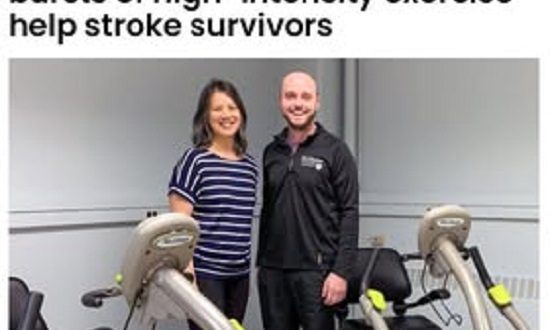
I’m sure you know the HITT training principle, yes? But now, stroke rehabilitation professionals now have firm evidence to support implementing short, high-intensity interval training protocols in clinical practice (and by extension, into the community).
A study published just last week in Stroke, the peer-reviewed scientific journal of the American Heart Association noted the first randomised trial to examine a time-efficient, high intensity interval training programme to incorporate a phased and progressive approach.
An adaptive recumbent stepper was used, which was justified in that in meant more people could participate in high-intensity interval training, even those who cannot walk fast enough or long enough on a treadmill.
For us stroke survivors, it suggests that with the right support and guidance, stroke survivors can safely and effectively engage in high-intensity interval training, significantly improving their overall health and recovery.
Kevin Moncion, Lynden Rodrigues, Bernat De Las Heras, Kenneth S. Noguchi, Elise Wiley, Janice J. Eng, Marilyn MacKay-Lyons, Shane N. Sweet, Alexander Thiel, Joyce Fung, Paul Stratford, Julie A. Richardson, Maureen J. MacDonald, Marc Roig, Ada Tang. Cardiorespiratory Fitness Benefits of High-Intensity Interval Training After Stroke: A Randomized Controlled Trial. Stroke, 2024;
DOI: 10.1161/STROKEAHA.124.046564

Over a million people reside with effects of stroke in the UK right now and over 85% of people who have had a stroke now survive. But everyone knows that it’s the biggest disabler of all and also that effective help tails off soon in the community – and that survivors unfortunately tend to decline rather than improve. Recovering from a stroke can feel like trying to find your way through a dense fog—challenging and disorienting. That’s where ARNI (Action for Rehabilitation from Neurological Injury) comes into play.

ARNI has been around for nearly two decades. Recently, it’s been gaining attention for its remarkable benefits, making it essential for every stroke survivor. ARNI is a game-changer in stroke rehabilitation. ARNI is a specialised rehabilitation program designed for survivors of neurological injuries. Unlike traditional hospital rehab that’s one-size-fits-all, ARNI emphasises one-on-one personalised and active rehabilitation with the emphasis on maximal dosage of repetitions to optimally stimulate plasticity per session. This approach is reported often to get better results in terms of movement return (often clear, incremental spasticity/flaccidity declines over time which have the effect of increasing action control) than traditional, more passive therapy modes.

ARNI does its best to reverse this latter trend by providing dedicated and intensive help… having proven over the years that it is possible, with effort, to guide people to achieve real rehabs & much better qualities of life.


We are on Facebook

ARNI